
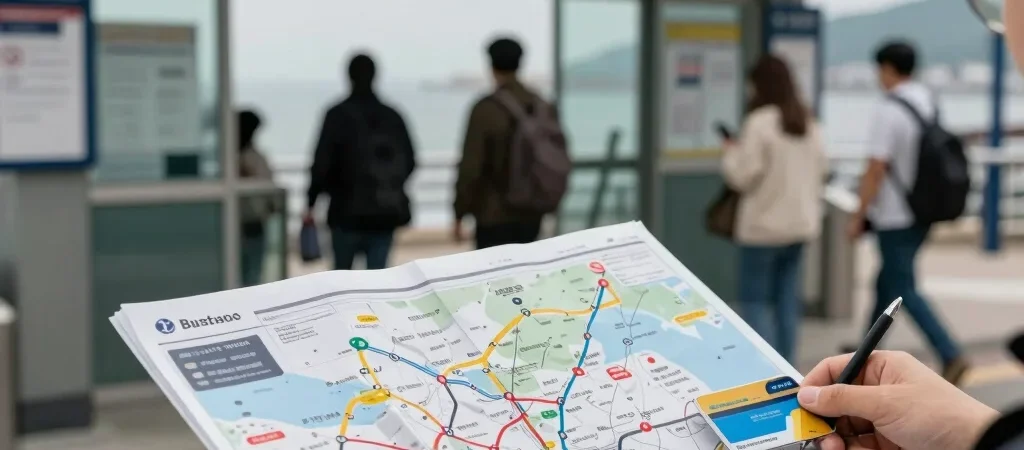
Your first Busan transit decision may come before you reach the city: Gimhae International Airport connects to the Busan-Gimhae Light Rail, with transfers to the metro at Sasang or Daejeo. Which transfer makes sense depends on where you are staying, so check the full route rather than choosing by the nearest station name. Once you understand the metro as a set of connections, Busan feels much easier to navigate.
Use the metro as your map
Busan Metro Line 1 runs through central stops including Nampo, Jagalchi, Seomyeon, and Busan Station; Line 2 serves areas including Gwangan and Haeundae. These are useful anchors, but the station is not always the front door to a destination. Check the exit and walking distance before you leave the platform, especially around markets, beaches, and hillside neighborhoods.
A reloadable Korean transit card can make metro and bus trips simpler than buying a single ticket each time. Check where your card can be purchased and topped up, and confirm the current fare and transfer rules locally, since details can change. Keep the card handy when entering and leaving stations, and follow the signs for transfer gates rather than exiting by mistake.
Plan the last stretch
Buses reach places the metro does not, but routes can be harder to interpret at a glance and some streets climb steeply. Use a current map app that supports Korean transit, compare the stop name with your destination, and keep the Korean name available to show a driver if needed. For a short, hilly final leg or late arrival, a taxi may be the less tiring choice.
Build a little slack into plans that involve a transfer or a bus connection. At major stations such as Seomyeon, allow time to follow the signs through busy corridors instead of assuming the platforms are side by side. Before heading out, save your accommodation’s address in Korean and check the first and last transit times for your route.
Make the route fit the day
Try grouping stops by area rather than crossing the city for every item on a checklist. Nampo and Jagalchi pair naturally; Gwangan and Haeundae make more sense as a separate stretch along Line 2. The practical rule is simple: pick one neighborhood cluster, then let the metro connect it to the next.